Career Opportunities
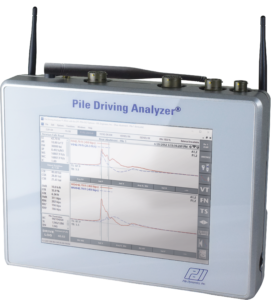
Pile Driving Analyzer® (PDA) System
High strain dynamic load testing and pile driving monitoring system. Perform dynamic load testing on most types of deep foundations.
Newsletter 109
Read Now

Free Webinars
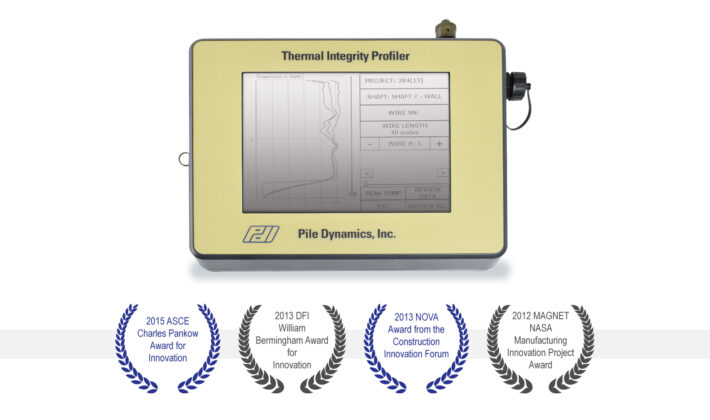
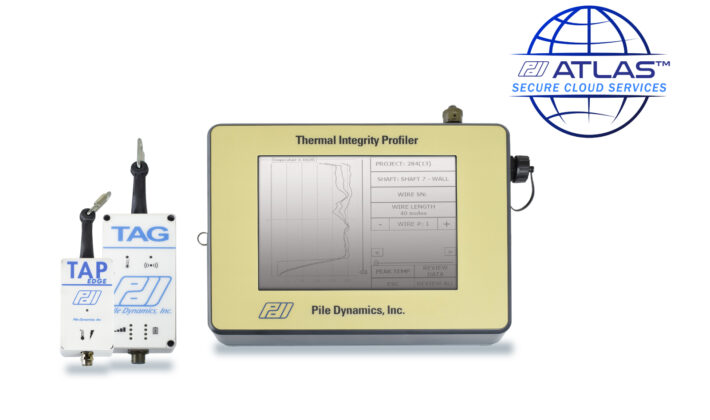
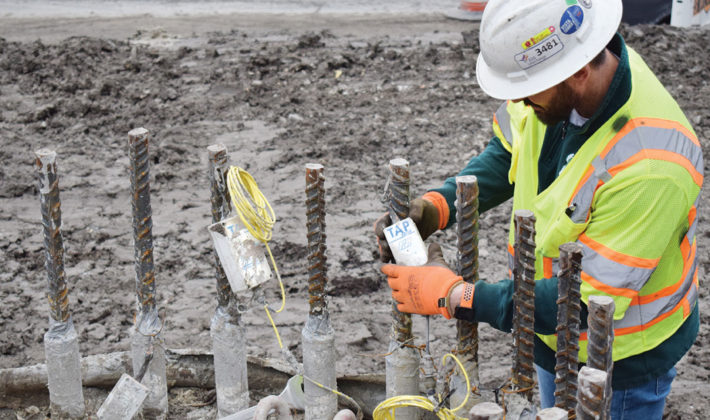
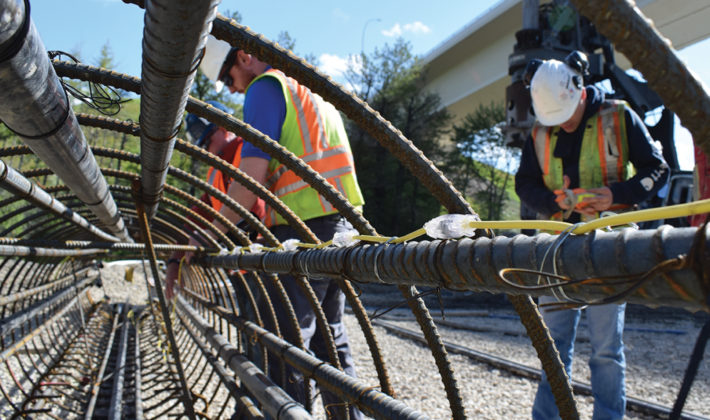
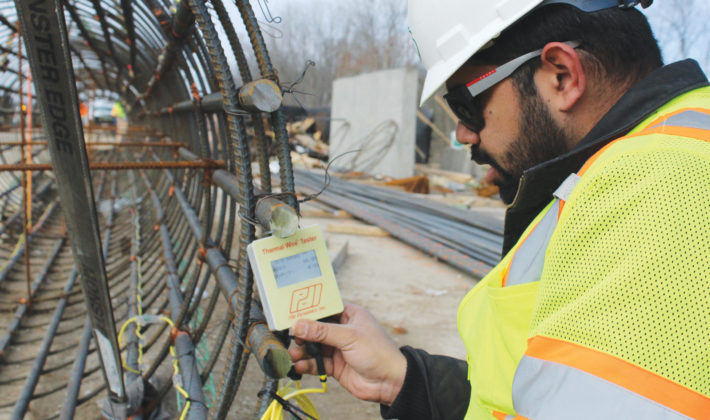
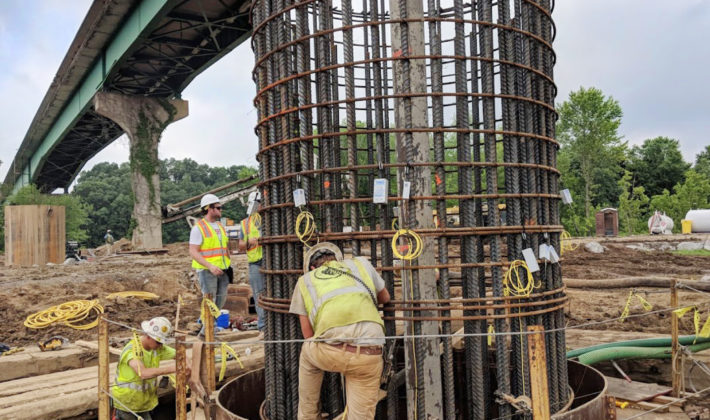
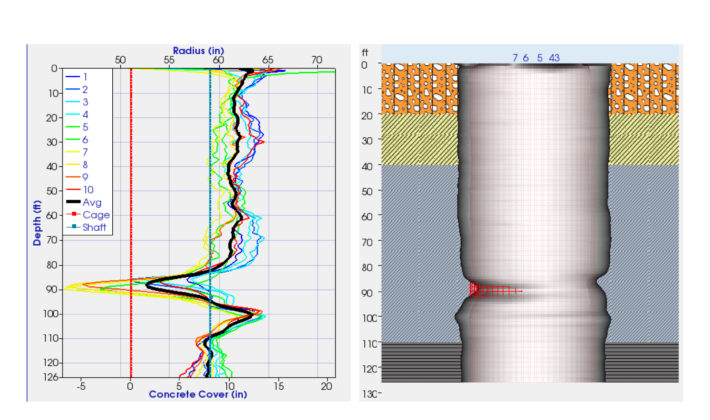


Evaluation of the entire cross-section and the entire length of the deep foundation element measuring heat generated by curing cement to assess the quality of drilled shafts/bored piles, augered cast in place (ACIP)/continuous flight auger (CFA) or drilled displacement piles, slurry walls, barrettes, soil nails, and jet grouted columns.
Have a technical question? Ask our team of engineers.
Request a quote CalculatorThe Thermal Integrity Profiler (TIP™) uses the heat generated by curing cement to assess the quality of drilled shafts and of bored, augered cast in place, continuous flight auger or drilled displacement piles. It may also be used for quality control and shape evaluation of jet grouting, slurry walls, and diaphragm walls. TIP™ evaluates the entire cross-section and the entire length of the foundation. Results are available shortly after shaft installation is concluded: TIP™ reveals necks or inclusions (regions that are colder than average), bulges (regions that are warmer than average), variations in concrete cover, and the shape of the shaft and cage alignment.
The average temperature within a concrete shaft is dependent on its diameter, the concrete mix design and on the time of measurement relative to concrete casting. Measured temperatures at the reinforcement cage vary with the distance to the center of the shaft and with the concrete cover.
The TIP™ starter system includes the TIP™ Main Unit and 12 Thermal Acquisition Ports (TAP-Edges), along with the TIP™ Reporter Software. THERMAL WIRE® cables (NIST traceable smart sensing cables fitted with uniformly spaced digital temperature sensors) are ordered separately depending on the length and quantity needed. The cables are tied to the rebar cage and cast into the shaft.
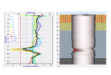
Data collected by the TIP™ system is downloaded to a computer for analysis by the TIP™ Reporter Software. The TIP™ Reporter Software displays measured temperatures versus depth and mapped on cross sections of the shaft to provide profiling data. The Thermal Integrity Profile software helps identify areas of concern such as potential over-pour bulges, necking, or cage alignment irregularities. TIP™ Reporter also estimates the concrete cover along the entire length of the shaft. In addition to TIP™ temperature measurements, this analysis requires the total concrete volume as an additional input. The estimated effective shaft radius, reinforcement cage location and the concrete cover of the reinforcement bars can then be determined.
The Thermal Profiling Method was developed at the University of South Florida and originally implemented by Foundation and Geotechnical Engineering LLC (FGE). Research and development are a joint effort of FGE and PDI. The TIP™ conforms to ASTM Standard D7949 – Standard Test Methods for Thermal Integrity Profiling of Concrete Deep Foundations.
1Cotton, D., Ference, M., Piscsalko, G., and Rausche, F., (2010) “Pile Sensing Device and Method of Making and Using the Same” US Patent 8,382,369.
2Mullins, A. G. and Kranc, S. C., (2004), “Method for Testing the Integrity of Concrete Shafts,” US Patent 6,783,273.
Main Unit
Physical
Size
272 x 212 x 60 mm (10.7 in x 8.3 in x 2.4 in)
Weight
2.04 Kg (4.5 lbs.)
Sunlight readable VGA color display for any lighting conditions, resolution 640 pixels x 480 pixels
Screen size
21.3 cm (8.4 in)
Temperature Range
Operating: -20º to 40º C (-4º to 104 º F); Storage: -30º to 65º C (-22º to 149º F)
Powered by Internal Battery (10-hour duration)
Data Storage
Built in 256 GB drive minimum
Data Retrieval
USB port or WiFi
Microsoft Windows® 10 or higher Operating System
Thermal Acquisition Port for Wires (TAP)
Size
133 x 102 x 57 mm (5.2 x 4 x 2.2 in)
Weight
340 g (.75 lbs.)
Temperature Range
Operating: -20° to 65° C (-4º to 149º F); Storage -40° to 85° C (-40º to 185º F)
Contains 1 installed Li-Ion battery or 0.64 grams ELC
Internal Rechargeable Battery (28-day duration)
Sampling frequency
User programmable, defaulted to once every 15 minutes
Hangs from reinforcement cage; may be bolted to cage for security
Water Resistant
Thermal Acquisition Port with cloud access for Wires (TAP-Edge)
Size
114 x 65 x 41 mm (4.5 x 2.6 x 1.6 in)
Weight
400 g (0.9 lbs.)
Temperature Range
Operating -20° to 65° C (-4º to 149º F); Storage -40° to 85° C (-40º to 185º F)
Contains 2 installed Li-Ion battery (14.8 W Hrs.)
Internal Rechargeable Battery (20-day duration)
Sampling frequency
User programmable, defaulted to once every 15 minutes
Hangs from reinforcement cage; may be bolted to cage for security
Water Resistant
Thermal Aggregator for Wires (TAG)
Size
160 x 80 x 57 mm (6.3 x 3.2 x 2.2 in)
Weight
580 g (1.3 lbs.)
Temperature Range
Operating: -20° to 65° C (-4º to 149º F); Storage -40° to 85° C (-40º to 185º F)
Contains 2 installed Li-Ion battery (22.2 W Hrs.)
Internal Rechargeable Battery (10-day duration)
Sampling frequency
User programmable, defaulted to once every 15 minutes
Hangs from reinforcement cage; may be bolted to cage for security
Water Resistant
Thermal Wire Tester Box for Wires
Size
133 x 102 x 57 mm (5.2 x 4 x 2.2 in)
Weight
766 g (1.7 lbs.)
Temperature Range
Operating: -20° to 65° C (-4º to 149º F); Storage -40° to 85° C (-40º to 185º F)
Contains 1 installed Li-Ion battery or 0.64 grams ELC
Internal Rechargeable Battery (28-day duration)
LCD Display Screen
Adapter cable included for splice cables and is required for spliced cables
Does not store data
Thermal Wire® Cables
Sensor type
NIST Traceable
Digital
Furnished in rolls of length starting at 6 m (20 ft) with length increments of 1.5 m (5 ft)
Sensor spacing
305 mm (12 in)
Sensor operating temperature
-20° to 105° C (-4º to 221º F)
Sensor Accuracy
±0.5º C (± 0.9° F)
Splicing
Multi segment cables available upon request – featuring quick-connect
Thermal Acquisition Port for Probes (TAPP)
Size
155 x 33 x 57 mm (6.1 x 1.3 x 2.2 in)
Weight
340 g (0.75 lbs.)
Temperature Range
Operating: -20° to 65° C (-4º to 149º F); Storage -40° to 85° C (-40º to 185º F)
Internal Battery (8-hour duration)
Contains 2 installed Li-Ion batteries (1.28 grams ELC)
Sampling frequency
Once per second, or as a function of depth (user adjustable)
Water Resistant
Probe
Sensor type
Infrared (four orthogonal sensors)
Size
130 x 30 mm (5.1 x 1.2 in)
Weight (Probe)
5.2 kg (11.5 lbs.)
Cable length
60 or 100 m (200 or 332 ft)
Weight (60 m Cable)
3.8 kg (8.4 lbs.)
Weight (100 m Cable): 9.5 kg (21 lbs.)
Sensor operating temperature
Up to 105° C (221º F)
Removable sensor head
Water resistant
Depth Measurement Unit
Type
Rotary Encoder
Resolution
2.5 mm (0.1 in)
Other
Soft carrying case
Full one-year warranty
Operates in English, SI, or Metric units
Technical manual provided in PDF form on a USB drive
The TIP includes a full warranty and technical support.

 PDI Family Brochure